
Signing With a Custom Perfume Manufacturer: Questions DTC Brands Skip
A custom perfume agreement is signed before the product exists, which means the document is describing a relationship rather than a thing. Direct-to-consumer brands tend to skip the same questions: who owns the composition, what the development fee actually buys, what happens if no direction is approved, and what the reorder looks like three years later. None of these is difficult to settle at the start. Each of them is expensive to settle after a launch, which is why they belong in the first written exchange rather than in a dispute.
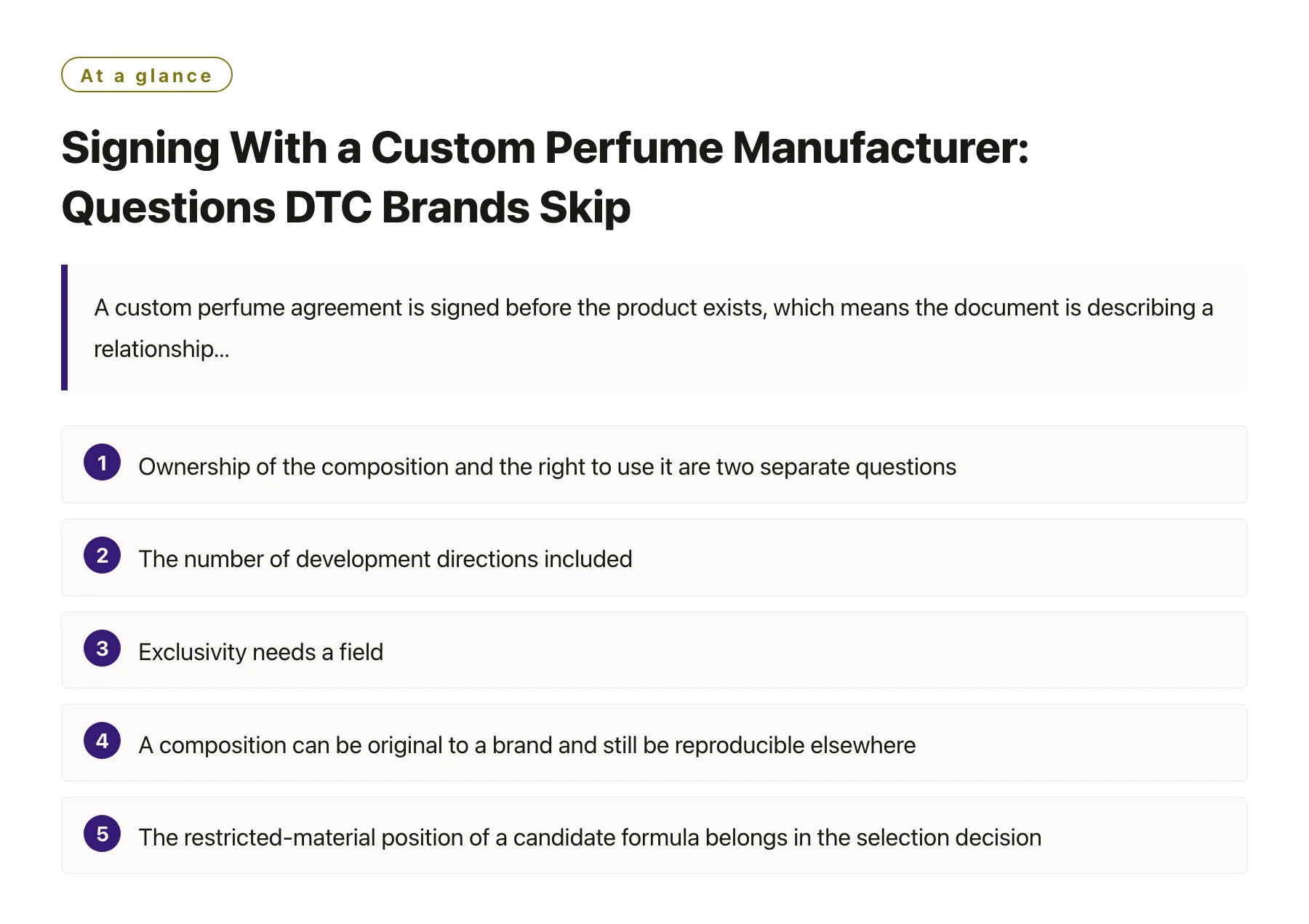
Key takeawaysOwnership of the composition and the right to use it are two separate questions, and a development fee does not automatically transfer the first. · The number of development directions included, and the price of exceeding them, defines the real shape of the project more than any headline figure. · Exclusivity needs a field, a territory and a duration, or it will not survive a change of management on either side. · A composition can be original to a brand and still be reproducible elsewhere, so the protection that matters is often contractual and registration-based as much as technical [1]. · The restricted-material position of a candidate formula belongs in the selection decision, not in a post-approval review [2]. · Testing, tooling and documentation are frequently outside the quoted development scope, and the agreement should say who commissions and who pays for each.
The signature usually happens during a pleasant period. The samples are promising, the relationship is new, and the commercial conversation has been shorter than expected. That is precisely the moment when a direct-to-consumer brand is least inclined to slow down and ask about termination, ownership and repeat pricing, and precisely the moment when the answers are easiest to obtain.
This article is organised by the area of the project each question protects, rather than by legal category. It assumes the brand has already chosen a manufacturer and is now negotiating the terms, and it assumes the brand sells its own product rather than supplying a retailer.
Most manufacturers will answer all of these questions happily. The reason to ask them in writing is not suspicion; it is that development projects run for months, involve several people on each side, and end with a product that is manufactured repeatedly.
Questions worth putting in writing, by area
| Question area | The question to put in writing | What a usable answer names |
|---|---|---|
| Development scope | How many directions does the fee cover, and what is charged for additional rounds? | A number, the cost of exceeding it, and the point at which the brief is treated as fixed |
| Composition rights | Who owns the formula, and what right does the brand receive to use it? | The rights granted, the field and territory they cover, and what happens on termination |
| Exclusivity | Is the scent exclusive, in which field, for how long, and from what date? | Field, territory, duration and whether neighbouring product categories are included or excluded |
| No-approval outcome | What happens if none of the directions is approved? | Whether further directions are included, credited or billed, and on what timetable |
| Testing | Which formula-and-package combinations will be tested, at whose cost, and who signs the report? | A list of combinations, the test conditions, the commissioning party and delivery of the report [3] |
| Tooling and artwork | Who owns the moulds, plates, screens or dies paid for by the brand? | Ownership, storage location, transfer conditions and the cost of retrieval on exit |
| Regulatory roles | Who prepares the safety assessment and the product information file, and who is named as the responsible party? | Named responsibilities, the documents exchanged and the markets they are intended to cover |
| Repeat orders | What governs the second and third order: minimum quantity, price validity, and what can trigger a change? | A stated minimum, a price validity period, and the specific events that allow a revision |
Eight areas, and most manufacturers will have a standard position on each. Where the position is uncomfortable, it is far better to learn that before the first purchase order than after the packaging has been printed. The exercise also produces something useful beyond the contract: a written summary the brand can hand to a new team member, an investor or a lawyer, describing exactly what the company has bought and what it holds.
The two questions that surprise direct-to-consumer brands
Ownership and regulatory role are the areas where direct-to-consumer brands are most often caught out, in part because the language is unfamiliar and in part because the assumed answer feels obvious.
Many manufacturers retain ownership of the composition and grant the brand a licence to use it in a defined field. That is a normal structure, and it can work perfectly well for a perfume sold under a brand's own name. What it does not support is a later decision to move the same scent to another supplier, or to sell the brand and transfer the scent with it. If portability matters, it has to be negotiated, and the negotiating position is strongest before the development fee is paid.
Ownership is not the same as protection
Even where a brand owns a formula, the composition itself may be independently reproducible, which is why registration routes such as design or trademark protection for the packaging and the brand identity often carry more practical weight than the formula clause alone [1]. The combination is what matters: a clear contractual position on the scent, and a registered position on the name and the bottle that a customer actually recognises.
A practical question to ask is what documentation the manufacturer will provide at the end of development: a formula record, a specification, a retained reference and the test reports. Those deliverables determine whether the brand can operate the product across a change of manufacturer, and they are much cheaper to agree up front than to request later.
Who speaks to the regulator
Selling cosmetics, including fragrance, brings obligations that sit with the party placing the product on the market. In many markets a direct-to-consumer brand is that party, even when the manufacturing is entirely outsourced. That makes the safety assessment, the product information file and the labelling inputs the brand's responsibility, and it makes the manufacturer's inputs to those documents a deliverable rather than a courtesy.
The contract does not need to resolve the legal detail, but it should record who prepares what, in which format, and within how many days of a request. Fragrance materials carry use restrictions that vary by product category, so this conversation also belongs in the formula selection stage, when a substitution is still inexpensive [2].
How to raise these without souring the relationship
Founders often avoid the question list because it feels adversarial at a moment when the relationship is going well. In practice, the framing determines the reaction. Sending a short note that says the brand needs to brief its own team and its advisers on the arrangement, and would like the manufacturer's standard position on eight points, is a normal commercial request. Manufacturers with a functioning process answer within a day, because the answers already exist in their standard terms.
A useful technique is to ask for the position rather than the concession. That keeps the exchange factual, gives the manufacturer room to explain why a term exists, and produces a record either way. It also reveals something about the working relationship: a partner willing to explain a term is easier to deal with in month nine than one who insists it is not discussed.
If the negotiation has to be compressed to three items, protect the number of development directions and the cost of exceeding them, the rights the brand receives over the composition, and the reorder terms. Those three determine whether the project can be finished without reopening the commercial discussion, whether the scent is still usable in three years, and whether the second order is priced predictably. Everything else, including payment staging and delivery windows, is easier to adjust later because it does not change what the brand owns. A manufacturer that has run a custom development programme many times will have a clean answer on all three already prepared, which is itself part of what a brand is buying when it chooses Xuelei custom perfume manufacturer over a trading company. It is also worth checking whether the partner's own model is development-led or production-led before the conversation, because that determines who expects to make the development decisions; the difference between a contract manufacturer for perfume brands and a partner offering full ODM fragrance service is exactly where those decisions sit, and the contract should reflect the model the brand actually chose.
Sources
- WIPO — World Intellectual Property Organization —— The UN agency for intellectual property; resources on industrial design and patent protection relevant to product and packaging design.
- IFRA Standards Library (International Fragrance Association) —— The IFRA Standards Library lists the restrictions the fragrance industry applies to individual fragrance ingredients, based on safety assessments; it is the reference point for compliant fragrance formulation.
- SGS: Cosmetics, Personal Care & Household Testing —— Testing, inspection and certification services for cosmetics and personal care, including microbiological, stability and safety testing aligned with cosmetics GMP.
Frequently asked questions
Does paying a development fee mean the brand owns the formula?
Not by default. Many manufacturers retain ownership and grant a licence to use the composition in a defined field. Both structures are common and workable, but the arrangement should be stated in writing rather than inferred from the fact that a fee was paid.
How long should exclusivity on a custom scent last?
There is no single correct duration, but the term should be long enough to support the brand's growth plan and specific about field and territory. An exclusivity clause without a defined field or market tends to be interpreted narrowly at exactly the moment it matters.
What should happen if we reject every sample direction?
The agreement should state it before it happens: whether further directions are included in the fee, credited against a later order, or billed separately, and how long the project stays open. This is the scenario least likely to be documented and most likely to be needed on a first development.
Who is legally responsible for a private label perfume?
In many markets the party placing the cosmetic product on the market carries the responsibility, which for a direct-to-consumer brand usually means the brand itself. The manufacturer supplies the formula, safety inputs, batch records and system documentation, but the product information file normally sits with the brand.
Should we ask for the manufacturer's standard terms before negotiating?
Yes. Asking for the standard position on each area is factual, quick and revealing, and it avoids framing the conversation as a set of demands. The answers also show how the manufacturer handles a documented request, which is a useful preview of how it will handle a documented problem.